3PL vs In-House Fulfilment: Should You Keep Packing or Hand It Over?
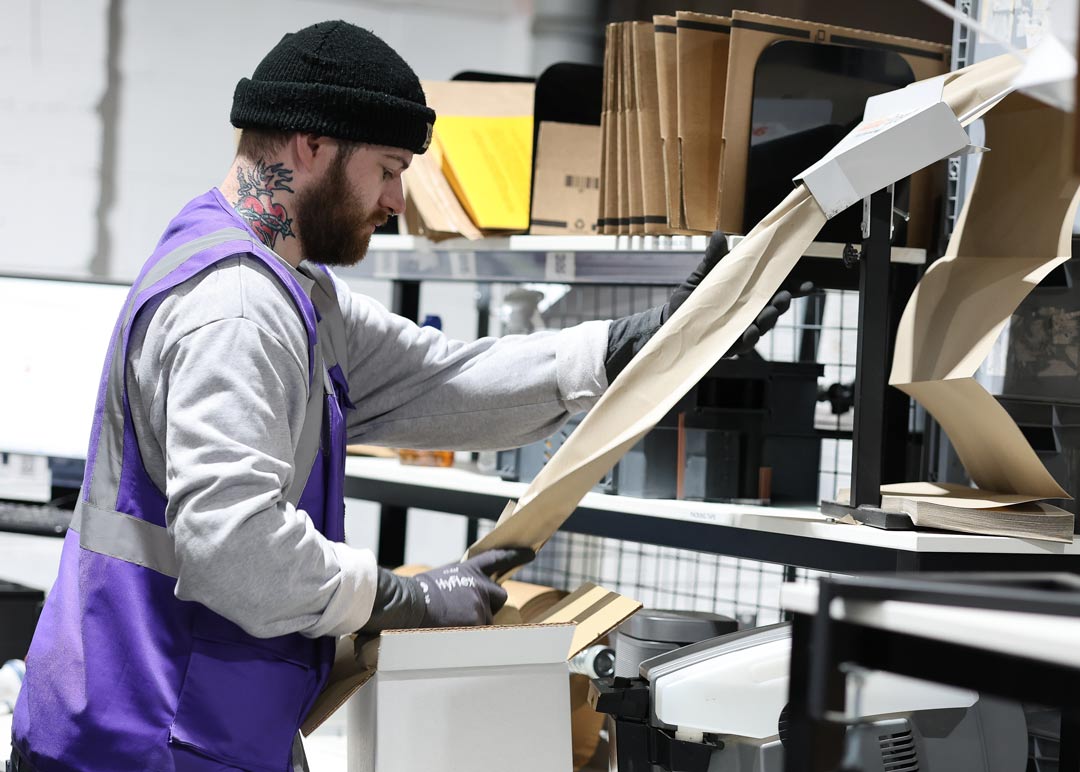
Keep fulfilment in-house while your orders are steady, your team has room to breathe and packing still feels like part of the fun. Bring in a 3PL when fulfilment starts setting the pace of your business instead of the other way round. The real question isn’t which option is cheaper on paper. It’s which one lets you grow without the wheels coming off.
What’s the difference between a 3PL and in-house fulfilment?
In-house fulfilment (or self fulfilment) means you and your team do it all: storing stock, packing orders and getting parcels out of the door from a space you run. With a 3PL, a specialist fulfilment partner takes that on from its own warehouse, plugged straight into your store. You still own the stock, the customers and the brand. You just stop owning the packing tape.
Here’s the bit that matters most, though. In-house fulfilment is mostly a fixed cost. A 3PL is mostly a variable one. Your rent, team and racking cost the same whether you ship 300 orders this month or 3,000. A 3PL charges for the space you use and the orders you send, so your costs rise and fall with your sales.
New to how fulfilment works from checkout to doorstep? Our complete guide to eCommerce fulfilment covers the basics. This one is all about the decision.
What does in-house fulfilment actually cost?
Usually more than you think. The costs rarely land on one tidy invoice. They’re scattered across staffing, rent, software subscriptions and, if we’re being honest, a fair few of your evenings. To get the full picture, add up:
- People. Your pickers and packers, plus holiday and sickness cover, training, recruitment and the extra pairs of hands you suddenly need in November.
- Space. Rent, business rates, service charges, utilities and insurance, ideally for the space you’ll need next year, not the space you’re squeezed into today.
- Equipment and materials. Racking, packing benches, label printers and packaging bought in small batches at small-batch prices.
- Software. Inventory, warehouse and shipping tools, plus the time it takes to keep them all talking to your store and marketplaces.
- Postage. Without serious volume behind you, those courier rates don’t budge much.
- Mistakes. Every wrong item or missing product turns into a reship, a refund or a return, and an awkward email to write.
Most of these costs stay put whether you have a bumper month or a quiet one. So every time orders dip, your cost per order quietly creeps up.
The cost nobody puts in the spreadsheet
Your time. If you or your senior team are still packing boxes, chasing collections or doing stock counts on a Sunday, those hours have a price. They’re hours you’re not spending on new products, wholesale deals, marketing or simply thinking about where the brand goes next. For a lot of founder-led brands, this turns out to be the most expensive line of all.
Is a 3PL cheaper than doing it yourself?
Not always. The only way to know for sure is to compare like with like.
Start by totting up everything in-house fulfilment costs you in a typical month: people, space, materials, software, postage and an honest figure for your own time. Divide that by the number of orders you ship and you’ve got your in-house cost per order. Then ask a 3PL to quote against your real order profile and work out its cost per order the same way, postage included. Our guide to 3PL fulfilment costs explained walks you through every line of a quote.
Two things usually tip the scales. The first is postage. 3PLs negotiate courier rates across all of their clients, and those savings alone can cover a big chunk of the fulfilment fees.The second is utilisation. In-house costs look great in your busiest month and painful in your quietest one, while a 3PL’s costs simply follow your volume.
Why does peak season change the maths?
Because fixed capacity leaves you with an awkward choice: pay for space and people you don’t need for most of the year, or come up short exactly when it counts. Most brands fulfilling in-house plan for an average month, then hold their breath through Black Friday, Christmas or a launch that does better than expected. That’s precisely when mistakes and delays do the most damage to your reviews.
A 3PL plans for peak across lots of brands at once. Extra people, longer shifts and additional courier collections are just part of the job, so a spike in your orders becomes a great sales week rather than an all-hands crisis.
When is in-house fulfilment the better choice?
There are plenty of good reasons to keep it in-house for now. Maybe your orders are low and steady, and your team is busy without drowning in overtime. Maybe every order is personalised or made to order, so packing is really part of production. Maybe you’re still experimenting with packaging and want to tweak the unboxing experience every week. Or perhaps your products are so bulky, fragile or unusual that they need very specialist handling.
If that sounds like you, carry on, and keep an eye on your cost per order every few months so you can spot the moment it stops adding up. Not sure if you’re there yet? These signs it’s time to outsource are a good gut check.
Signs you’re ready to outsource
Most brands don’t decide to outsource on a particular day. Fulfilment slowly takes up more of the week until it’s running the business. If several of these sound familiar, it’s worth getting a quote.
- Packing has taken over your evenings. The orders are great news, but you’re boxing them up at 10pm instead of planning next quarter.
- Orders are leaving later than you promised. Next-day delivery has quietly become “a few days”, and customers are noticing.
- Small mistakes are creeping in. Wrong sizes, missing inserts and more “where’s my order?” emails than you’d like.
- You’ve run out of room. Stock has spread from the spare room to the hallway, or you’re about to sign a lease on a unit you’ll have to staff.
- You dread peak season. Black Friday should be your best week of the year, not the one you just try to survive.
- You’re saying no to growth. A retail account, a new marketplace or a big influencer push feels risky because you’re not sure you could ship it.
- Europe is on the wish list. Selling to EU customers from a UK spare room means customs paperwork on every parcel, and since July 2026 every low-value parcel attracts duty too.
- Postage is eating your margin. You’re paying full price for courier rates that a 3PL negotiates across all its clients.
- Everything stops when you do. If orders pause whenever you’re ill or on holiday, fulfilment depends too much on one person.
Ticking three or more? The next step is to compare like with like, using the cost-per-order method above. If you’re already with a 3PL and these signs still sound familiar, that’s a different problem, and our guide to switching 3PL provider covers it.
Will you lose control with a 3PL?
This is the big worry, and it’s a fair one. Your brand is your baby. But with the right partner, you don’t lose control. You just hold it differently.
In-house, you control fulfilment by being in the room. With a 3PL, you control it through a written packing spec, your own branded packaging and inserts, live stock and order data you can check whenever you like, and an account manager who actually knows your brand.Get that right and your customer experience usually becomes more consistent, because every order is packed to the same standard, whoever happens to be on shift.
Can you use a 3PL and fulfil in-house at the same time?
Absolutely, and plenty of growing brands do. You might keep personalised or made-to-order lines close to home while a 3PL ships your core range. You might use a 3PL just to take the pressure off at peak. Or you might keep UK orders in-house while a partner looks after a new market. For brands selling into Europe, holding stock with a fulfilment partner inside the EU is often the first step, and our complete guide explains the UK and EU rules that make it worth a look.
The one non-negotiable with a hybrid setup is a single, accurate view of your stock across every location. Without it, you’ll be selling out in one place while boxes gather dust in another.
What does moving from in-house to a 3PL involve?
Far less drama than most brands expect, as long as it’s planned properly. Here’s how it usually goes:
- Share your data. Your 3PL will want your product list, sizes and weights, order history and packaging requirements so it can quote accurately and plan your storage.
- Connect your store. Your eCommerce platform and marketplaces get hooked up to the 3PL’s systems, and test orders run before anything goes live.
- Agree the packing spec. Packaging, inserts, gift notes, bundles and any special handling all get written down, so every order leaves exactly how you want it to.
- Move the stock. Your stock arrives at the warehouse and gets counted and checked in. Many brands keep a small buffer at home during the changeover so orders keep flowing.
- Go live and fine-tune. Orders switch over, and the first few weeks are spent tightening things up with your account manager.
The golden rule? Timing. Don’t switch in the run-up to your busiest period, and give yourself enough breathing room to move stock and test everything properly. Already with a 3PL and thinking of moving? Our guide on how to switch 3PL provider has you covered.
So, 3PL or in-house?
Work out what in-house fulfilment really costs you, compare it honestly with a 3PL quote for your actual orders, and think about where you want the business to be in twelve months, not just where it is today. If in-house still comes out on top and it isn’t stealing your time from the work that grows the brand, stick with it. If the numbers are close, or you’re the one being stretched, it’s probably time to hand over the packing tape.
SCEND helps growing brands scale with eCommerce fulfilment services from our UK and EU fulfilment centres, shipping worldwide. Want to see how the numbers stack up for your brand? Speak to the team.
Frequently asked questions
Is it cheaper to use a 3PL or do fulfilment in-house?
It depends on your volumes. In-house fulfilment is mostly a fixed cost, so it can work out cheaper when orders are low and steady and your team is fully used. As volumes grow or become more seasonal, a 3PL is often cheaper per order once you count staff, space, software, postage and your own time.
How do I compare in-house fulfilment costs with a 3PL quote?
Add up a typical month of in-house costs, including staff, rent, materials, software, postage and your own time, then divide by the number of orders you ship. Compare that with a 3PL’s all-in cost per order for your real order profile, postage included.
What is the difference between a 3PL and a fulfilment centre?
A fulfilment centre is the warehouse where stock is stored and orders are picked, packed and shipped. A 3PL is the company that runs fulfilment for other businesses, usually from one or more fulfilment centres, and often offers extras such as returns and kitting.
What is the difference between a 3PL and a 4PL?
A 3PL does the hands-on work of storing, picking, packing and shipping orders. A 4PL manages a brand’s wider supply chain on its behalf, often coordinating several 3PLs, carriers and suppliers rather than running a warehouse itself.
What does in-house logistics mean?
In-house logistics means a business runs its own storage, order fulfilment and shipping using its own premises, people and systems, rather than outsourcing that work to a third-party logistics provider.
Can I use a 3PL and fulfil some orders in-house?
Yes. Many brands run a hybrid model, keeping personalised or made-to-order products in-house while a 3PL handles their core range, peak overflow or a specific market. It works best when you have one accurate view of stock across every location.
How long does it take to move fulfilment to a 3PL?
It depends on your product range, integrations and stock levels. The process covers sharing product data, connecting your store, agreeing a packing spec, moving and checking in stock, then going live. It’s best to avoid switching just before your busiest period.